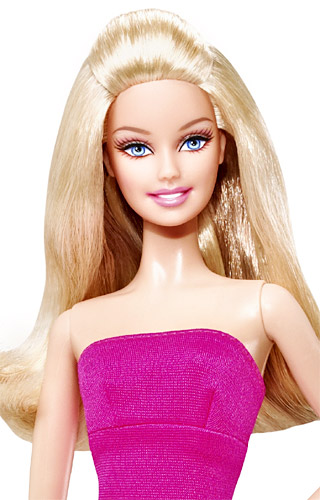
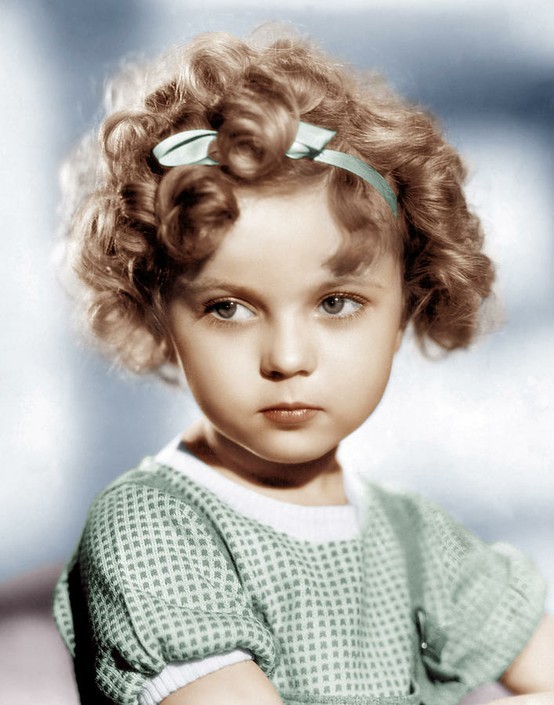
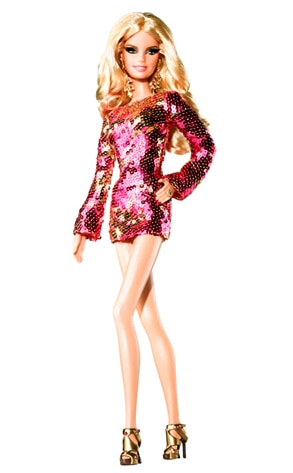
Throughout the centuries, young children often look up to various role models and icons and emulate and try to be like them. Young girls particularly feel as if they must look and act perfect in order to fit in to society and be liked. In Toni Morrison's The Bluest Eye, Shirley Temple and Mary Jane are the prominent figures in which young black and white girls look up to. In today's world it is no different. Even though the racial prejudices shown in The Bluest Eye are somewhat gone now, the perfect looking figures that children look up to are still here, such as Barbie dolls. Typically, Barbies are white skinned with blonde hair, blue eyes, and a perfect body. Because many girls in the United States own a Barbie at a young age, they are being taught how they should to look and act in the eyes of society. Similarly, Shirley Temple was seen as the 'perfect' girl in the 1940s, which is why so many children, including Pecola, felt inferior when they did not look the same way.

One character in the novel, Pecola Breedlove, comes from an unstable family that is viewed as ugly by society. They live right above a store in one of the worst parts of town, and the store consists of glass walls. The glass walls represent the Breedlove's as a display for society to see; a display of something ugly and undesirable. Their humiliation is not private and they are hyper visible; people know that they are there but choose to stereotype them. Just by looking at the Breedlove family, you "wondered why they were so ugly; you looked closely and could not find the source...It was as though some mysterious all-knowing master had given each one of them a cloak of ugliness to wear, and they had each accepted it without question. The master had said, 'You are ugly people.' They had looked about themselves and saw nothing to contradict the statement; saw, in fact, support for it leaning at them from every billboard, every movie, every glance" (39). There is no distinct ugliness about the family, however, society automatically pegs them as undesirable because they look nothing like what is considered 'beautiful'. Beauty, as shown in "every billboard, every movie, and every glance," was perceived as being white, just like Shirley Temple and Barbie. Even though today's modern society likes to think that we have grown to be more diverse and that any person can be beautiful, there are still the same expectation that are shown in The Bluest Eye. In fact, our society today relies even more on trying to fit into this role of beauty, by going to extremes to be 'pretty' and look more like a Barbie.

Given her unstable family, Pecola finds it hard to embrace and find beauty in her natural self, causing her to want to change, and be more like the 'beautiful' little girls: Shirley Temple and Mary Jane. Pecola lives vicariously through these icons on a regular basis. Claudia says that Pecola "was fond of the Shirley Temple cup and took every opportunity to drink milk out of it just to handle and see sweet Shirley's face" (23). Pecola could not be more different than Barbie and Shirley Temple, however, she feels a slight bit of empowerment when she gets to at least see Shirley Temple. She does that same thing with Mary Jane candy. Pecola yearns for the blue eyes of Mary Jane, and "to eat the candy is somehow to eat the eyes, eat Mary Jane. Love Mary Jane. Be Mary Jane" (50). Pecola ignores any bit of uniqueness that she has just so she can be more 'beautiful', even if it is just for a few moments. Because she is so unhappy and dissatisfied with the way she looks, Pecola feels as if the one thing that could fix her discontentment would be to have blue eyes. Girls in the twenty first century lack this confidence as well and think that if they somehow look more similar to Barbie- a bit skinnier, prettier, or different looking in some way- they will be happier. This self degradation has always occurred in children because they see that the most beautiful icon, either Shirley Temple or Barbie, looks nothing like them.

The exaggerated 'beauty' and perfectness of a Barbie is unrealistic and gives children false pretenses as to what they should look like. Society has manipulated children through advertisements and social icons, however, sometimes it is hard to actually discover where the true beauty lies in these figures. Similarly, Claudia is given a white doll for Christmas, and spends a copious amount of time dissecting the doll, trying to find out the 'beauty' in it that everyone talks about. Even though, "adults, older girls, shops, magazines, newspapers, window signs- all the world had agreed that a blue-eyed, yellow-haired, pink-skinned doll was what every girl treasured," Claudia is not yet convinced (20). Most people view a Barbie as beautiful because that is what they see advertised every day as being pretty; any look different from this is often considered not as beautiful. American society forces people to judge others by looking at their physical qualities and automatically pegging them as either beautiful or ugly.

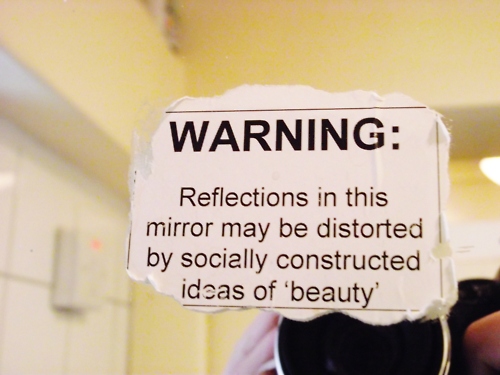
 When you look in the mirror, what do you see? Obviously, no one is able to see what they really look like, because only flat mirrors will produce a true reflection, and due to even the slightest manufacturing errors, household mirrors are never perfectly flat. However, the reflection that is reciprocated when you look in the mirror is extremely close to how everyone else sees you. Even so, some people perceive their reflections in a mirror from minute to far fetched exaggerations of how their reflections appear. People who deal with anorexia or bulimia fall on the extreme and "far fetched" side of this spectrum, but on the opposite end of the spectrum, there are people who are consumed with the thoughts of an imperfect appearance. Where does this insecurity come from? There is no evidence that people are somehow born with insecurities of their appearance or behavior, so what continues to perpetuate this "condition" in today's society? For one, the media plays a monumental role in declaring what is perceived as "beautiful" and what is not through photoshopped photos of supermodels gracing magazine covers, and the idolization of handsome or beautiful actors and actresses who appear to have it all. As a result, many people end up altering their identities and personalities to fit society's standards.