Showing posts with label social mobility. Show all posts

Thursday, October 25, 2012

The Rush: From Glengarry Glen Ross to China's Education System

We are the victims, but this is the only chance.


National College Entrance Examination

        National Higher Education Entrance Examination, known as Gaokao in China, is the annual nationwide exam that almost every high school undergraduates must take in order to be admitted to colleges. It is considered as the toughest test in China.
Well, the SATs are child’s play compared to the Gaokao. If the SATs are the academic equivalent of, say, a brisk footrace, the gaokao is an Iron Man triathlon. Across a minefield and through a piranha-infested river that ends in a waterfall. With people throwing ninja stars at you the whole time! Freaking ninja stars.

        For Chinese high school students, there is almost no way to go to colleges academically without a NCEE score. Throughout the nation, Gaokao is the most significant event for each teenager because their career and future depend heavily on this exam, which directly determines which college they go to. It is controversy in China nowadays because it gives students too much pressure and generates unfair opportunities based on different regions. 

       The normal study time for a high school senior in school is 10 hour, and they are supposed to work until midnight. In order to compete with others, many schools have Saturday classes for all high school undergraduates, and extra classes on some courses on Sundays for some of the students. When becoming an undergraduate, there is almost no time for entertain or extracurricular. In addition, opportunities are exceedingly unevenly distributed among the nation by Gaokao. As people are rushing to the universities in Beijing, and Shanghai, in which the best universities are located, universities in these cities set strict baselines for each province, which favor the local Gaokao takers a lot because the universities admit local students a lot more than outsiders.


How many students are wearing glasses in this video? Why? :)

Most recently, photographs emerged of a classroom in Hubei province, showing students taking energy-boosting amino acids from intravenous drips hung from the ceiling. --BBC News.

The Machines and Academic Hierarchy


        Under the great pressure of Gaokao, more and more high school students become "study machines". Sixteen-hour study time is normal to most of the students. Gaokao takers are categorized by Arts and Science. Arts students will have six subjects: Chinese, English, math, politics, history, and geography; science students have six as well: Chinese, English, math, physics, chemistry, and biology. In the first year of high school, they will learn all of them, and at the beginning of the second year they will choose or "be chosen" to be categorized, and they can not switch for the remaining two years. Such extensive range of courses requires plenty of effort and time, and it keeps making students "study machines". Furthermore, there is little time available for high school students to do sports, activities, clubs, and games. More and more people become fat or weak not because they eat a lot, but because they don't move at all. 
        Such machines can be found in Glengarry Glen Ross by David Mamet; the salesmen say that they are machine. They are so disappointed at the world because they keep trying to sell people the land that they don't want. 
Aaronow: Shelly, the Machine, Levene (Mamet, 64).
Roma: It's not a world of men, Machine... it's a world of clock watchers, bureaucrats, officeholders... what it is, it's a fucked-up world... there's no adventure to it. We are the members of a dying breed (105).
These "study machines" in China will have more than ten mock Gaokao exams during their last year in high school, and their ranks are always told for estimation. In some school during the first two years, students have almost as many exams as they will have in the last year. Some of the exams are designed to categorize students. This system makes different levels of class available to students at different ranks. The high level classes, consisting of the top-ranked students at the same grade, will have the best teachers in school and different treatment, including teaching and homework; they learn things at a faster speed and have some "extra accessibility" of knowledge. The low level classes, however, will take a relatively slow pace and are less productive. This classification of students can be found at not only in high school, but also primary schools, middle schools, and colleges everywhere in China.
Levene: Get the chalk and put me on the board. I'm going to Hawaii! Put me on the Cadillac board, Williamson (63).
Such classification is similar to the board system in Glengarry Glen Ross. The salesman who close the leads, get on the board, and the more they close the better leads they will get, which gives them better opportunities to close again. This unfair system will result bigger distinction among people.

Education Inequality and Social Mobility

        Gaokao has a strong influence in China society. Many children are under strict care of parents about their academics at a young age. For parents, in order for their kids to have a better education in high school, they have to get the appropriate middle schools and primary schools, as well. Since the admission for high school and middle school are also based on one exam similar to Gaokao, children have pressure at a unusually young age. In addition, this system allows bigger and bigger gaps among students since the better ones get the much better education while the lower ones keep getting the lower level education all the time.
        Education inequality happens also in rural and urban areas. Rural areas have an extreme difference from urban areas in economics, and such distinction results a broad range of education levels in different regions. To a family in rural areas, the only hope that they could one day be rich and move to the big city is relied mostly on their children. However, it is way harder for a kid to get to university because the school can not afford higher-educated teachers or advanced facilities. Early in 21st century, there would be a celebration in a town if one were admitted by a university. They see this as a chance of social mobility. Unfortunately, such fortune had rarely happened to poor families. To some extent, education is a key reason why the poor get poorer and the rich get richer in China.


Sources not linked:
Mamet, David. Glengarry Glen Ross. New York: Grove Press, 2012. Print. 

Saturday, September 15, 2012

Not Enough Life Boats: Social Class in the Titanic and the Great Gatsby


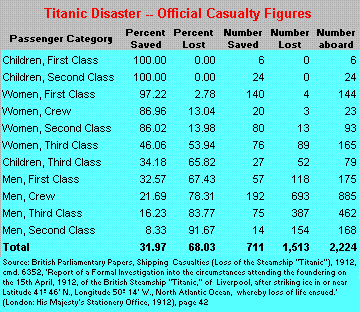
     When the unsinkable “Ship of Dreams”, Titanic, hit an iceberg on April 14, 1912, during her maiden voyage, roughly 1500 people perished in the icy waters of the Atlantic.  This great maritime disaster has been immortalized in popular culture through James Cameron’s 1997 film Titanic starring Leonardo DiCaprio and Kate Winslet.  In addition to being a touching love story, the movie delves into the reality of social class boundaries in the early twentieth century, that the social strata into which a person is born defines their life, and even death.  Among the first class, people are not permitted the freedom to marry for love or befriend inferiors because of the necessity to maintain the money and titles in the hands of the aristocrats; their lives become void of surprise and emotion.  The people who attempt to transcend the borders of class, the “new money” passengers, still face condescension from those of “old wealth”, even though they possess the same monetary status because they are seen as “infected” by their poor past.  Despite all of the passengers being “in the same boat” as the ship plunges into the depths, their socioeconomic roles decide their fates because those holding first class tickets have priority of survival over the people in the second and third class. 

     The protagonist, Rose DeWitt Bukater, is an upper class, seventeen-year-old girl whose betrothal to thirty-year-old Cal Hockley was arranged by her mother so as to maintain her wealth after her father left them greatly in debt.  Near the beginning of the film, Rose attempts to commit suicide by jumping off of the stern of the ship because she sees no other way out of her societal prison–her strictly regimented life in which she has no control or freedom.  The elder Rose, who narrates the story to treasure hunters in the modern day, describes her dilemma:
“I saw my whole life as if I'd already lived it. An endless parade of parties and cotillions, yachts and polo matches. Always the same narrow people, the same mindless chatter. I felt like I was standing at a great precipice, with no one to pull me back, no one who cared... or even noticed.”
Despite having the greatest privileges, Rose is trapped by her status because the thrill of all of the activities which she attends is blocked by the deliberate lack of emotion in all of the gatherings.  She calls her acquaintances “narrow” and “mindless,” showing that, to them, the world is a playground, and none of the world’s problems strike them with initiative.  She feels that the upper class is a cold place where people do not care about anyone besides themselves, money, and the family name.   One of the major decisions in her life, her husband, was made for her, demonstrating that in her world, people’s fates are determined whether they like them or not.  To take control of her own fate, Rose nearly dives into the Atlantic, but a young third class passenger, Jack Dawson, persuades her to climb back onto the ship.  Over the course of the movie, Jack teaches Rose how to go about life looking forward to new, exciting things, living from day to day.


This spontaneity intrigues her, but Rose is constantly wavering on her connection to him because her mother looks down upon Jack, persisting in advocating on behalf of Cal.  She finally decides to abandon her place in the upper class world in pursuit of love, reclaiming her freedom and breaking away from the social class pyramid.   

 
    Outside of Jack and Rose's love story across the social hierarchy,  the "Unsinkable" Molly Brown faces discrimination from the other first class ladies because she is "new money."  Instead of welcoming her into their high society, they look down upon her.  When she tries to join them for tea, they see her coming and leave the room.  Her last name, "brown", is a common surname with no particular associations to royalty or wealth, proving that to truly be accepted in the plutocratic world, you must both have money and a title.  Without both, the dream may as well be dead.  Still, Molly does not give up on her American Dream, and even tries to help Jack fit into his surroundings.  She gives him the means to dress like a gentleman, as well as provides him with pointers on how to interact with the elite.  
"Ain't nothing to it, is there, Jack? Remember, they love money so pretend like you own a gold mine and you're in the club."
While she does not quite understand that she is not entirely welcome in the aristocratic society, she at least makes the effort to leave the door open to success behind her, instead of slamming it shut like the rest of the first class passengers.  

     When the Titanic becomes a life or death situation instead of a pleasure cruise, a seat in a life boat suddenly becomes the most valuable thing in the world.  Instead of carrying adequate space in life boats for all of the passengers aboard, Titanic had only twenty boats, enough for about half of the little over two thousand customers.  When boarding the boats, women and children are loaded on first–women and children of the first class, that is.  
When Rose and her family are ushered over to one of the lifeboats, her mother is more concerned with class separation than everyone's survival.  
Ruth: "Will the lifeboats be seated according to class? I hope they're not too crowded."
Rose: "Oh mother, shut up! Don't you understand? The water is freezing and there aren't enough boats. Not enough by half. Half the people on this ship are going to die."
Cal Hockley: "Not the better half."
It is clear that even in the face of a terrible disaster, Cal and Ruth are still so caught up in their own superiority complex that they deny the meaning of the life of a third class passenger.  Unfortunately, the ships crewmen, too, operate on this philosophy that the lives of the rich are more valuable, locking the third class ticket holders behind bars in the lower decks.  Some of the lifeboats are only loaded to half capacity, trying to increase the comfort and safety of those aboard.  At one point, Cal tries to bribe his way onto a boat.  Once the Titanic is fully submerged, and fifteen hundred people are treading the freezing water, Molly Brown tries to convince her life boat to turn around to rescue some of the people, but gains no support from her selfish shipmates.  


     Like on Titanic, in early twentieth century America, the setting for F. Scott Fitzgerald's The Great Gatsby, class determined fate.  When Gatsby falls in love with Daisy, he knows they are doomed because as a member of the lower class, he "had no real right to touch her hand" (Fitzgerald 149).  Similar to Jack Dawson, Gatsby feels like he does not belong in the upper class world, that every second he spends with Daisy is a moment stolen.  When Daisy is given the choice between financial security and class with Tom and Gatsby's "spectroscopic gaiety", she makes the opposite choice from Rose, allowing her fate to be controlled by her name instead of her desires.  Daisy, like Rose's mother, considers "new wealth", the American Dream, to be appalling because it "herded its inhabitants along a shortcut from nothing to nothing" (107).  Daisy views this emerging class in the same way that the first class passengers see Molly Brown–as an invasion into their exclusive club of money and titles.  In the same fashion that the third class deaths from Titanic are seen by the first class women as "collateral damage" or unimportant, the deaths of Gatsby, Myrtle, and George are forgotten by Tom and Daisy Buchanan because they "smashed up things and creatures and then retreated back into their money or their vast carelessness" (179).  Daisy does not return for Gatsby's funeral despite her role in causing his death, but rather simply moves on with her life, staying in her comfortable, upper class, carefree lifestyle with her husband Tom.    Likewise, once the lifeboat carrying the first class women is safely away from the sinking ship, it does not come back to save the lives of others.  The rich proceed with their lives like a "deathless song", while the poor or formerly poor suffer and die around them (96).  Titanic and The Great Gatsby both imply that, in this time period, the social hierarchy was incredibly hard to overturn, and when it came down to life and death situations, those at the top of the pyramid would prosper while those below would perish.  

Tuesday, August 14, 2012

This Land Belongs to Sharon Jones


This land is your land, this land is my land
From California to the New York Island
From the Redwood Forest to the Gulf Stream waters
This land was made for you and me.
It’s probably one of the most popular songs in American history, covered by many great singer-songwriters, but also sung by parents to children and choruses of kids at camp: “This Land is Your Land,” originally composed by the great American folk musician Woody Guthrie in 1944. The song is probably most appreciated today as an uncomplicatedly positive statement about the democracy of the United States, a land that belongs to all people, where anyone with enough hard work and determination can buy that house in the suburbs or that plot of land in the countryside. At the time it was composed, however, Guthrie was actually protesting the increasing privatization of the American landscape. As his guitar reads, “This Machine Kills Fascists”—and he wasn’t talking about the ones in Germany. In many ways, he was standing up for the George Wilson’s of America against the Tom Buchanans, the working class versus the elite. While Tom waltzes freely into George's shop and steals his wife, we cannot imagine George doing the reverse, can we?


Guthrie and his guitar

Sharon Jones and the Dap-Kings

There was a big high wall there that tried to stop me;
Sign was painted, it said private property;
But on the back side it didn't say nothing;
This land was made for you and me.

When the contemporary rhythm and blues singer Sharon Jones sings “This Land is Your Land” with the Dap-Kings, the meaning of the song takes on a whole new connotation. First there is the simple fact that a black woman is singing the lyrics. “This land is my land” just means something different for a white man and a black woman in America. Let’s remember that blacks have been in this country as slaves nearly as long as they have been here free. Even in 1944, could a black woman, or even a black man for that matter, travel freely and safely from "California to New York Island"? To say that such movement is possible, then, from the perspective of an African American woman, is a powerful statement of property ownership and civil rights made by the descendent of slaves. Moreover, the “Private Property” signs of one of Guthrie’s alternative verses included in the Dap-Kings version take on a whole new meaning, reminding the listened of similar signs during the Jim Crow South that specifically limited the movement of African Americans in ways more marked and dangerous than Guthrie’s and other white men ever experienced. 


Then there’s the music, which unlike the lyrics, are significantly altered from the original Guthrie tune. Rather than the simple and singular folk guitar of Guthrie, an individual statement, The Dap-Kings that back Jones are a multi-instrument ensemble, featuring not one but three guitars, drums, and a suite of horns. The song thus becomes a statement about the rights of the group, not just the individual, as if to say, everyone deserves this land, not just the few. Moreover, the musical aesthetic of this version of “This Land is Your Land”—as with most releases off the Daptone label, borrowed from directly for Amy Winehouse's Back to Black—is distinctly Motown, referencing a pivotal moment in black musical entrepreneurship in the 1960s that corresponded with the height of the Civil Rights Era. Motown played a crucial roll in integrating the American music scene and bringing black-owned, -produced and -performed music to white audiences. The sound of the track, then, is the soulful sound of black musical and economic power, emphatically stated in the crisp, clipped horn parts that seem to echo the lyrics of the song similarly laying claim to the “land” of America. Huh!


The original Motown
Ball so hard, this shit weird
We ain’t even s’pose to be here,
Ball so hard, since we here
It’s only right that we be fair. 
- Jay-Z, "Niggaz in Paris" 
When Nick and Gatsby are passed on the Long Island Expressway by a limousine full of African Americans being chauffeured by a white driver, the narrator thinks, "Anything can happen...even Gatsby could happen" (73). It’s a remarkable scene for Nick in part because these African Americans enjoying their freedom represent a major social change over the past few decades in American history. In the first half of the twentieth century, blacks left the South in record numbers and settled in Northern cities like New York, hoping for a better life. The Harlem Renaissance, that flourishing of black artistic culture in the 1920s, was happening at the same time that The Great Gatsby was written and represented a significant shift in American race relations. But given Tom's racist comments at the beginning of the book, though, this success was limited. There was still much poverty and suffering for African American migrants arriving in the North and it would take . Again, while we might imagine Gatsby and Nick going to a Harlem jazz club with Daisy and Jordan, it's hard to imagine the same racial diversity at one of Gatsby's parties. The movement of African Americans was still limited. 


(This scene is such a meaningful and powerful one, I was not surprised to see it featured in the trailers for the new Gatsby movie, along with a sample from Kanye West and Jay-Z’s “Church of the Wild”--it's one of the first shots as the camera zooms in on New York City at the opening of the clip. I'm also not surprised that a track from Watch the Throne was chosen for the 2013 The Great Gatsby. That album's obsession with fame, fortune, and the American dream is shared by many characters in the book. I doubt though that Gatsby would tolerate his Rolls being taken apart the way that Ye and Jay do to the Maybach in the video for "Otis"!)