Showing posts with label The Bluest Eye. Show all posts

Friday, October 26, 2012

Wall Street (1987)

Wall Street (1987)

While you are reading my Blog, you can listen this song as a background music. "Money" by Pink Floyd. 


Wall Street is a classical business crime movie. The movie talks about how Wall Street really looks like. A young man just graduated from New York University named Bud Fox, he is a stock salesman. He has to repay all the loans for his studying. Although he is extremely hard working, he struggling a the bottom of Wall Street. In the movie, every successful people can find their previous lives on Bud. By chance, he uses his intelligence to talk with Gekko. Gekko is a typical capitalist, all he cares is about money. Gekko says if Bud wants to join his company, Bud should do something which can interest him. Bud gets lots of information from his father, his college friends and his associates. These information are available for Gekko to do the inside trading. Although inside trading is illegal, it can make easy money. After Bud works with Gekko, he got everything he wants, money, luxury house and beauty. But when Gekko ready to dissolve and contradict the promise to sell the Blue Star, which is company that Bud’s father works there, Bud feels full of guilt. Finally, Bud got his conscience and justice again. He fought against Gekko and saved the Blue Star. He is also arrested by police because of the inside trading. 


Napoleon said that a successful man only exists in two places: on horseback and on woman. In the peace era, there is no war. People cannot ride the horse and kill the enemies. But on the stock market or the financial market, you can find the feeling. Through the computers and networks, you could be flight in an invisible battlefield. You could be a general or a commander. Dispose all the money in the stock market is like you are managing thousands of troops. This is a zero sum game. There would be people who get lots of profit, and there would be people who lost all the money. 
As Gordon Gekko said, “You see that building? I bought that building ten years ago. My first real estate deal. Sold it two years later, made an $800,000 profit. It was better than sex. At the time I thought that was all the money in the world. Now it's a day's pay.” 


Bud Fox: How much is enough? 


Gordon Gekko: It's not a question of enough, pal. It's a zero sum game, somebody wins, somebody loses. Money itself isn't lost or made, it's simply transferred from one perception to another.


This implies how they desire for the money. People cannot earn all the money in the world. There should be a limited. But for Gekko, he is so greedy that he thought earning money should not have a limit. He said the stock market is a zero sum game. But for him, it is an unfair game. He uses his information to control the stock. Although it is illegal, and many people has chance to report Gekko, they didn’t do so. Because they are also “greedy”.  


Conflicting among greedy, money and humanity happens every second in movie. In reality, it also happens. Even though people work so hard and they are full of ambitions, they are struggling on the edge of survival. Those people do not work; however, they have inside information. They make tons of money every day. At this moment, those poor people may change their beliefs and principles of justice. 

This is like what Gekko said to Bud, “Hard working? I bet you stay up so late to analysis those stocks that you want me to buy, right? What’s the advantages? My dad is a salesman for electronic components. He worked so hard everyday, but died of a heart attack at 49. He also owned lots of taxes which is not paid.”


“Greed, for lack of a better word, is good. Greed is right. Greed works. Greed clarifies, cuts through, and captures, the essence of the evolutionary spirit. Greed, in all of its forms; greed for life, for money, for love, knowledge, has marked the upward surge of mankind and greed, you mark my words, will not only save Teldar Paper, but that other malfunctioning corporation called the U.S.A.”
This is what Gekko said when he was at the shareholder’s meeting. I thought it’s pretty meaningful. In the Wall Street, “greedy” is not a negative vocabulary. The greedy is a spark which can provoke people doing better. 


This is about the Gekko's Speech. 


I feel this movie has the common point with Glengarry Glen Ross. Both of the main characters are so greedy on money, though Bud changes his mind at last. And both of them use a cheating way to earn illegal money. I think this could be a familiar phenomenon in 1980s society. People expect the imaginary American Dream too much. In their dream, the standard American Dream should be lots of money, a nice house which is described in The Bluest Eye, and the mother takes care of her children. But all those things are based on money. If you have no money, then the dream would be collapsed. So people start to earn money in a immoral way. 


This is a standard American Dream, a nice house, the gorgeous front yard and a married couple. That is what exactly described in The Bluest Eye


In the Wall Street, Gekko wants to purchase the Blue Star, which he can make a huge profit on that. But he knows the result, if he do so, he would destroy the whole company. Thousands of works would be employed. This would create starving among the civil. Gekko doesn’t care about anything but money. 
Gekko said, “It’s all about bucks, rest of the conversation.” 


In the Glengarry Glen Ross, there is one part that Moss tries to ask what's the name of the Blake, because they never meet before. Blake said "F*** you" to Moss. He doesn't even refer to them by their names. All he cares is about money. The way that he provokes those people to work is brutal. He made a huge "class difference" in the office. It just like the difference between Blake's BMW and Moss's Hyundai. He doesn't care how much time and energy that salesman put in, the only thing he cares is profit. There is no sympathetic relationship between Blake and the salesmen. 


If you are interested in economy, I recommended you to watch this movie

Sunday, October 14, 2012

The Reflection in the Mirror: When the "Inferiority Complex" of Modern Day America Meets The Bluest Eye


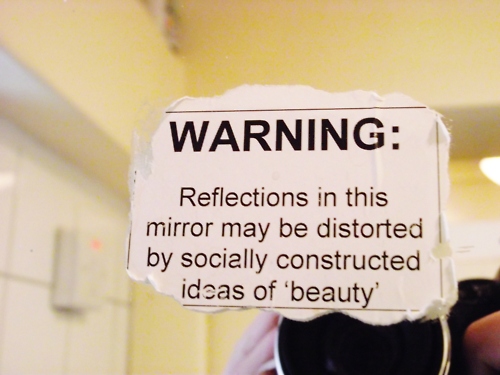
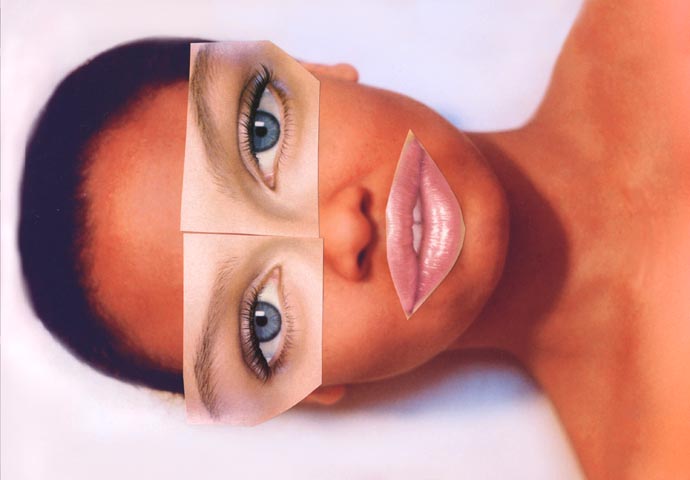
When you look in the mirror, what do you see? Obviously, no one is able to see what they really look like, because only flat mirrors will produce a true reflection, and due to even the slightest manufacturing errors, household mirrors are never perfectly flat. However, the reflection that is reciprocated when you look in the mirror is extremely close to how everyone else sees you. Even so, some people perceive their reflections in a mirror from minute to far fetched exaggerations of how their reflections appear. People who deal with anorexia or bulimia fall on the extreme and "far fetched" side of this spectrum, but on the opposite end of the spectrum, there are people who are consumed with the thoughts of an imperfect appearance. Where does this insecurity come from? There is no evidence that people are somehow born with insecurities of their appearance or behavior, so what continues to perpetuate this "condition" in today's society? For one, the media plays a monumental role in declaring what is perceived as "beautiful" and what is not through photoshopped photos of supermodels gracing magazine covers, and the idolization of  handsome or beautiful actors and actresses who appear to have it all. As a result, many people end up altering their identities and personalities to fit society's standards.
Barbie Dolls: Is this how we define beauty?
From an early age, young American girls are exposed to these "socially constructed ideas of 'beauty'" through Barbie Dolls. Barbie's perfect body shape, accentuated curves, beautiful complexion and blonde hair impress a certain idea of "beauty" upon the minds of children. An awareness of this dangerous impression on the minds of young girls has led to the manufacturing of different races of Barbie Dolls, and even a variety of Barbies characterized by respectable occupations, but ultimately, Barbie's constant state of "perfection" has left America with two questions: how do we define beauty, and what are the consequences of this definition? To this day, it seems as if America is bought into the "Barbie Doll" definition of beauty; however, the answer to the second question has become a controversial one. Many campaigns have originated as a result of the population's cry for change. The Dove Campaign for Real Beauty beginning in 2004 and continuing to the present day arose through an awareness that society's definition of beauty "had become limiting and unattainable". The destructive effects of this definition has left only 2% of women in the world claiming to feel beautiful and another 98% with a lack of confidence characterized by Alfred Adler's "Inferiority Complex". In short, this complex instigates a low self-esteem, which consists of feelings of "intense insecurity", or a fear of not measuring up. This sense of inferiority can be intensified to a degree in which a person believes that they can never compensate for the aspects that make them "imperfect" in comparison to society's standards of beauty, or it can be acted upon through exaggerated aggression in trying to overcome the complex.


Michael Jackson in 2005
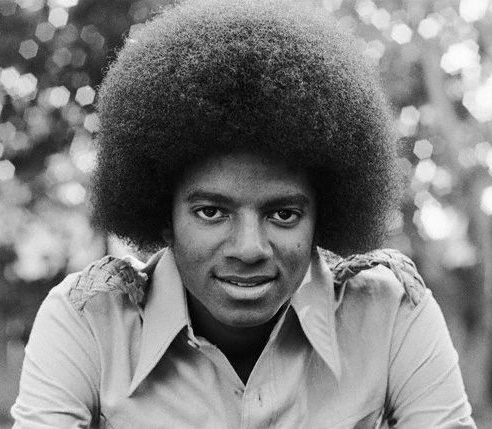
Michael Jackson circa 1970s
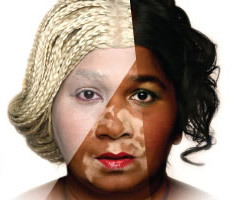
Contrary to the popular belief that teenage boys are unaffected in the same way that girls are by the media with regards to the definition of beauty, 54% of girls and 41% of boys ages 13-19 are dissatisfied with their appearance. One of the most popular male icons of modern day America, Michael Jackson, severely augmented his physical appearance through plastic surgery and skin bleaching, leaving him almost unrecognizable. Although Michael claimed his reasons for surgery to be medically based, many people believe that there was an underlying "Racial Self-Loathing" of his "inferiority complex" that influenced his transformation. Although his dermatologist and others close to him supported his claim that he suffered from "vitiligo", which Michael claimed as his reason for turning his skin white, race cannot be completely separated from the equation. He went as far as getting rid of his wider nose, characteristic of many blacks, to choosing a skinnier, more defined nose, characteristic of many caucasians. Furthermore, a certain "Afro-denial" as the comic, The Boondocks illustrates, is demonstrated in Michael's longer, straighter, black hair circa 2005.

Similarly, Toni Morrison demonstrates the detrimental effects of socially constructed ideas of beauty and what is acceptable in The Bluest Eye. Many characters suffer from an "inferiority complex" that leaves them struggling with their own identities apparent through their questioning of and conformity to socially constructed ideas of beauty. 

In receiving the stereotypical gift of a "big, blue-eyed, Baby Doll" for Christmas, Claudia MacTeer begins to question the legitimacy of society's social construct of perfection and beauty. 
I had only one desire: to dismember it. To see of what it was made, to discover the dearness, to find the beauty, the desirability that had escaped me, but apparently only me. Adults, older girls, shops, magazines, newspapers, window signs-- all the world had agreed that a blue-eyed, yellow-haired, pink-skinned doll was what every girl child treasured (20).
Like the adolescents of today's society, Claudia's family is affected by the perpetuation of society's standards of   beauty. They bought Claudia the baby doll because they were enchanted by the idea that this baby doll represented a way for Claudia to fit in to society's definitive standards. However, Claudia's "inferiority complex" forced her to investigate the origins of the standard of perfection manifested through the doll. She claims the "desirability had escaped her" illustrating a consciousness of her worthlessness according to society's standards, and acknowledges the influence of the "shops, magazines, newspapers, and window signs" in formulating society's definition of beauty. However, as soon as she dismembers the doll, she discovers the fake, manufactured facade of this baby doll demonstrated through "a mere metal roundness", or the battery, that keeps the doll functioning (21). When Claudia looks in the "mirror" she sees a girl that refuses to believe the socially constructed ideas of beauty, but she also sees that any attempt to counter this stereotype would be futile because of her race. She is left with conflicted feelings and a state of mind that refuses to let her believe she is worth anything.

Contrarily, Geraldine deals with her "inferiority complex" in the opposite way. Geraldine conforms to the standards set by society because she is attempting to overcome her "inferiority complex" through compensating for it in the only way she knows how: bourgeois respectability. Geraldine's attempts are illustrated in Morrison's words characterizing Geraldine's lifestyle.
Here they learn the rest of the lesson...how to behave. the careful development of thrift, patience, high morals, and good manners. In short, how to get rid of the funkiness (83).
Geraldine longing to get rid of the so-called "funkiness" that represents her rich African American heritage, parallels the skepticism that surrounds the reasons for Michael Jackson's nose job and drastic skin color transformation. Geraldine's "racial self-loathing" consumes her, and she longs to conform to American society's definitions of beauty and what is acceptable in order to eradicate the "inferiority complex" from her life. However, despite her various attempts, she is unable to measure up to the unattainable standards of perfection and is left broken when she ends up "in the second row, her white blouse starched, and blue skirt almost purple from ironing" (82).

Friday, October 12, 2012

The Doubted Certainties: Morrison's Critique of American Ideals


Rules are inevitable. The disastrous nature of human conduct generates the need of a governing central power and of policies that everybody must abide to as lawful citizens. Scientific and mathematical developments also bring about theorems and rules that are universally accepted as certain and true. While these essential and fundamental laws establish themselves in human minds, so do other more obscure and abstract social rules and standards of beauty and hierarchy, driving people to accept and follow the ideals and creating social division and hierarchy.


The Golden Age of Certainty
Isaac Newton, 1642 - 1727
The Age of Reason, often referred to as the Enlightenment or the Mechanical Age, depicts an era of physics development when the scientists aimed to take everything apart and to analyze them thoroughly. They believed in the possibility of defining and interpreting the behavior of all particles with mathematical analysis and proposed that the motion of an object from one stationary point in time to another is always connected and continuous. This idea of continuity suggests that if the position and momentum of a particle are determined, its state at any time in the future can also be predicted. Isaac Newton, an important physicist and mathematician of the era who developed the use of calculus (the mathematics of continuity) in his laws of motion, put forth a relevant idea: the clockwork universe theory. He stated in the theory that the world functions as a clock created by God, and all the particles in the universe advance, just like machines, with the linear progression of the clock and follow the general rules of Newtonian mechanics, leaving all moments in time entirely predictable. However, as Newton argues for the predictability of future events, he completely abandons the idea of free will. Since everything is certain and predetermined, nothing happens on the basis of human will.


The Age of Uncertainty
Quantum mechanics, however, deconstructs the widely believed notions of the Age of Certainty and challenges the Newtonian mechanism. Originally proposed by Heisenberg and later revised by Kennard, the uncertainty principle asserts a limit to the precision of the momentum and position of an object that can be determined. Heisenberg argues that the more precisely the value of one is known, the less precisely the value of the other can be determined. The principle challenges Newton’s earlier idea of continuity, in which the predictability of future states is based on the knowledge of the position and momentum of the particle in its present state. Another central argument of the quantum theory is that particles do not move in a continuous way, but instead come in discrete units. For instance, the position of an object at one moment in time is completely independent of its position in the previous moment; likewise, its position in the next point in time is also absolutely random and uncertain.


Certainty in The Bluest Eye
These two opposing extremes can be applied to Toni Morrison’s novel The Bluest Eye. In the novel, Toni Morrison depicts a society that functions similarly to the one presented in the Age of Certainty. The society displays the seemingly certain and inalterable ideals of beauty and hierarchy and runs like Newton’s clock, leaving no free will or possibility of change to the minorities in the society. The poor, instead of appreciating their unique natural self and their own identity, strive to approach the standards of the whites and to be accepted by the society. Geraldine, a middle-aged black woman, rejects her own identity and conforms to the certainties of the society:
They come from Mobile. Aiken. From Newport News. From Marietta. From Meridian. And the sounds of these places in their mouths make you think of love. When you ask them where they are from, they tilt their heads and say "Mobile" and you think you've been kissed. They say "Aiken" and you see a white butterfly glance off a fence with a torn wing. They say "Nagadoches" and you want to say "Yes, I will." (81)
          As an introduction of her in the book, Morrison chooses not to present a specific character but instead to generalize with the plural “they,” emphasizing Geraldine’s lack of individuality and her conformity to the American ideal of beauty as presented in the Dick and Jane story. She, along with many other black girls, tries to look and behave like the whites, searching for ways to straighten her hair and soften her skin. The girls have no pride or appreciation for their ethnicity and culture and show resentment towards their own race in attempt to fit into the white society and to approach the certainties that the white society present them with.


The Deconstruction of Certainty
Despite the failure of various characters’ attempts to challenge the fixed system of ideals and their ultimate conformity to the standards, Morrison attacks the certainty of the society by alluding to the harm and destruction it brings to the characters’ life. Morrison opens the novel by presenting the Dick and Jane story, which serves as an embodiment of the American ideal and are taught to children not only for English-learning purposes, but also for them to understand the American culture and the accepted values such as gender and family roles:

Here is the house. It is green and white. It has a red door. It is very pretty. Here is the family. Mother, Father, Dick, and Jane live in the green-and-white house. They are very happy. See Jane. She has a red dress. She wants to play. Who will play with Jane? See the cat. It goes meow-meow. Come and play. Come play with Jane. The kitten will not play. See Mother. Mother is very nice. Mother, will you play with Jane? mother laughs. Laugh, Mother, laugh. See Father. He is big and strong. Father, will you play with Jane? Father is smiling. Smile, Father, smile. See the dog. Bowwow goes the dog. Do you want to play with Jane? See the dog run. Run, dog, run. Look, look. Here comes a friend. The friend will play with Jane. They will play a good game. Play, Jane, play.
  
Here is the house it is green and white it has a red door it isery pretty here is the family mother father dick and jane live in the green-and-white house they are very happy see jane she has a red dress she wants to play who will play with jane see the cat it goes meow-meow come and play come play with jane the kitten will not play see mother mother is very nice mother will you play with jane mother laughs laugh mother laugh see father he is big and strong father will you play with jane father is smiling smile father smile see the dog bowwow goes the dog do you want to play do you want to play with jane see the dog run run dog run look look here comes a friend the friend will play with jane they will play a good game play jane play  
 HereisthehouseitisgreenandwhiteithasareddooritisveryprettyHereisthefamilymotherfatherdickandjaneliveinthegreenandwHitehousetheyareveryhappyseejaneshehasareddressshewantsToplaywhowillplaywithjaneseethecatitgoesmeowmeowcomeaNdplaycomeplaywithjanethekittenwillnotplayseemothermothErisverynicemotherwillyouplaywithjanemotherlaughslaughmOtherlaughseefatherheisbigandstrongfatherwillyouplaywithjaNefatherissmilingsmILefathersmileseethedogbowwowgoestheDogdoyouwanttoplaydoyouwanttoplaywithjaneseethedogrunRundogrunlooklookherecomsafriendthefriendwillplaywithjaNetheywillplayagoodgameplayjaneplay (2)
 Over the course of two pages, however, Morrison takes away the spacing and the punctuations, destroying the vision of the ideal household and leaving the whole piece meaningless and insignificant. By tearing the story apart, Morrison hints that underneath the façade of certainty, the values in the Dick and Jane are only fabricated deceptions that bring children to learn to respect the idealized and constructed cultural values and lose their own individuality.


The Destruction of Certainty
Pecola Breedlove, a poor black girl who stands at the very bottom of the social hierarchy, barely receives any love in her childhood experience and learns that the reason her mother prefers the white little girl more than her and the reason her classmates mock and isolate her is because she is poor, ugly, and, unlike the popular white girls in her school, does not have blue eyes. Driven by the longing for love and people’s attention, she accepts “blue eyes are beautiful” as an established and certain rule, yearning and praying to attain them. 


Ironically, Cholly, the only character who is willing to reach her and offer his love, does so in a perverted and inappropriate way. He, just like Pecola, did not grow up in a loving environment, has not been loved, and does not now how to love because of his low social status and his race. Pecola, as a result of the sexual violation his father repeatedly performs on her, is driven mad at the realization of the remoteness of the ideals from her. She, as Claudia points out, almost becomes an embodiment of ugliness that they look upon to uplift their own esteem. Because of the pressure the ideals and the so-called certainties have put on her, Pecola has to comfort herself with a imaginary friend and imaginary blue eyes to get a sense of confidence and involvement in the society. 


By demonstrating the effect these constructed ideals of beauty and American values have on Pecola, Morrison effectively depicts and argues against the destructiveness of certainty. 

Likewise, the ideals turn Soaphead Church into a pedophile.

Geraldine, in her appreciation for white beauty, abandons her own family. 

The carefully constructed world of ideal values and certainty is gradually falling apart. 


The Appreciation for Uncertainty—Morrison's Call for Naturalness

Morrison's attack on certainty also reflects through her writing style. While the Age of Reason proposes a linear progression of time, Morrison sides with the uncertainty and intentionally offers a more free-styled and circular narrative with the use of seasons and multi-perspective in the book. Her rather random form of narrative, with multiple narrators speaking in erratic orders, coincides with the idea of independent and discreet units in quantum theory, where the next moment is always uncertain and subject to change, implying the possibility for the minorities in the book to change their fate and to advance in the social hierarchy. Morrison, mainly through the voice of Claudia in The Bluest Eye, attacks the certainty of ideals and standards of the American society and calls for appreciation for the black’s unique “funkiness of nature” (83).

Unlinked Sources:
Morrison, Toni. The Bluest Eye: A Novel. New York: Vintage International, 2007. Print.

The Door: Americanization of Immigrants and African Americans


Americanization is a fascinating process that generations of sociologists have attempted to explain. In 1782, a French-American writer proudly praised the country as a melting pot, with Utopian visions of the emergence of an American “new man”. However, American history is fraught with clamorous and silent confrontations, persistent clashes of different cultures, and heated debates about values. After the ninety-seventies, the desirability of assimilation was challenged. Advocates of pluralism coined the alternative metaphor of a salad bowl, in which cultures mix but maintain their distinct shapes. 


In Prospective Immigrants Please Note, Adrienne Rich, a half-Jewish, half-gentile poet, offers a multifaceted interpretation of the Americanization. On one hand, she warns the immigrants of losing their ethnic traditions. On the other, she hints at the danger of rejecting assimilation. Ultimately, she expresses a desire for personal choice and self-determination: an immigrant should be free to select elements from his home culture and American (in this case, mainly white) culture. She writes about the same belief using personal experience in Split at the Root: An Essayon Jewish Identity. 


Prospective Immigrants Please Note  

       Adrienne Rich 


Either you will 
go through this door 
or you will not go through.  

If you go through 
there is always the risk 
of remembering your name.  

Things look at you doubly  
and you must look back
 and let them happen.  

If you do not go through 
it is possible 
to live worthily

to maintain your attitudes
to hold your position 
to die bravely  

but much will blind you, 
much will evade you, 
at what cost who knows?  

The door itself makes no promises. 
It is only a door.


 Inside, or Outside

Either you will/go through this door/or you will not go through. 

Door is a widely used literary symbol, very likely due to the complexity and duality its simple structure unifies: an open door signifies opportunity and acceptance, whereas a closed door symbolizes rejection and disappointment; an opening door is often associated with new adventures, and a closing door usually stands for farewell. In the poem, to “go through this door” means to assimilate, to Americanize, and to blend in. The outside is immigrants’ native culture, and the inside is American (in the context of this poem, white) culture. “Either…or” has the connotation of arbitrariness, suggesting that whether a person successfully Americanizes is judged by others.


The first stanza as a whole implies that the society demands a devotion to American standards from immigrant. The society does not recognize immigrants as complex, autonomous individuals. Immigrants are either embraced as new Americans, or regarded as outsiders. Therefore, should anyone strive to reconcile two sides of the door, incorporating some aspects of Americanness into his cultural background, the society demands him to forfeit one for the other.
This door metaphor, though written for immigrants, applies to colored people well. In The Bluest Eye, Toni Morrison explores African Americans’ quest for identity. Morrison presents most people as eager conformers, shedding their racial identity in order to go through the door. The character Geraldine represents mulatto girls religiously pursue “white” appearance and manners.
“The dreadful funkiness of passion, the funkiness of nature, the funkiness of the wide range of human emotions. Wherever it erupts, this Funk, they wipe it away; where it crusts, they dissolve it; where it drips, flowers, or clings, they find it and fight it until it dies… when they wear lipstick, they never cover the entire mouth for fear of lips too thick, and they worry, worry, worry about the edges of their hair” (83).


Funk refers to various natural imperfections of humans: body odor, breath odor, skin crusts, “lips too thick”, “edges of their hair”… For African Americans, “funk” includes their blackness. Geraldine is therefore fighting against her nature, against her African American descent. The words “erupts”, “crusts”, “drips, flowers, or clings” animate the funkiness, as if the girls view it as some kind of stubbornly, indefatigably growing weeds. Their light complexion, white manners, and property have sent them through the door: the society gives them a place above the black people. But they have to cautiously watch what they have attained, and continue the battle against “funk”, totally denying their African American identity.

 The Insiders’s Loss

If you go through/ there is always the risk/ of remembering your name. 
In the second stanza, “name” represents vernacular. Since language is the agent of culture and traditions, “remembering your name” means the awareness of racial and ethnical identity. “The risk” is the anxiety and fears of any exposure of the nature self.

Jewish Immigrant Family


In Split at the Root, Adrienne Rich recounts her father’s influence on her. The man is a second-generation immigrant. When young Adrienne was casting Portia in The Merchant of Venice, he instructed her to read the word “Jew” with scorn and contempt. She could see there was “a kind of terrible, bitter bravado” about her father’s instruction, yet she hesitated at questioning him. It was when she became a college student that she began to understand her father. One day she bought a dress in a small shop and a Jewish seamstress came to do alterations for her. She recalls,
“Something about her presence was very powerful and disturbing to me. After making and pinning up the skirt, she sat back on her knees, looked up at me, and asked in a hurried whisper: ‘You Jewish?’ Eighteen years of training in assimilation sprang into the reflex by which I shook my head, rejecting her, and muttered, ‘No’.”
Adrienne Rich realized that the image of a frightened immigrant, a wandering Jew terrified her, an American college girl having her skirt hemmed. “And I was frightened myself,” she wrote, “because she had recognized me.”
Geraldine attests to Adrienne Rich’s realization. When Geraldine returned home and her son Junior accuses Pecola of killing the cat, she looks at Pecola and abhors the lowness of black girls. “You nasty little black bitch. Get out of my house.” she says (92). The fact that she herself is black generates no magnanimity, because Pecola is an undesirable reflection of her race. Pecola’s blackness instigates Geraldine’s insidious contempt and self-denial, as Geraldine is reminded that she can be ostracized from the “white” middle-class for her blackness.

Double Consciousness 

Things look at you doubly /and you must look back/ and let them happen.  


The third stanza, interestingly, describes a kind of double vision: an immigrant’s action is judged by both cultures he is associated with, and he examines himself in two perspectives: an immigrant; an American. This idea is strikingly similar with W. E. B. Du Bois’s “double consciousness”, which he states as “this sense of always looking at one’s self through the eyes of others, of measuring one’s soul by the tape of a world that looks on in amused contempt and pity”. 


The experience of immigrants parallels that of African Americans with Americanization being the common direction. Both groups are painfully aware of their difference from the Anglo-Saxon race and voiceless in the white-dominant society. In the Bluest Eye, the discrimination and indifference of others throws Pecola into the conviction that she is hopelessly ugly, so “she would never know her beauty. She would see only what there was to see: the eyes of other people” (46-47). That all she would see were others’ eyes implies that Pecola is preoccupied with people’s views about her. She consents unconditionally to whatever labels the world puts on her- “you must look back/and let them happen”.


The Outsiders' Loss

If you do not go through /it is possible /to live worthily

to maintain your attitudes /to hold your position/ to die bravely  
but much will blind you, much will evade you, at what cost who knows? 

What complicate the poet’s argument are stanzas four through six. Fourth and fifth stanzas offer a romantic depiction of ethnic nationalism: by adhering to traditions and upholding cultural values, immigrants can live respectably and worthily. However, the sixth stanza points out that those who refuse to Americanize face costs.

Adrienne Rich identifies the Jewish defense against non-Jews as a quality required for survival over generations of persecution. Jews must arm themselves in a world full of potential slanderers, betrayers, people who “could not understand”. However, she questions, “What happens when the white gentile world is softly saying ‘Be more like us and you can almost be one of us?’ What happens when survival seems to mean dosing off one emotional artery after another”? She portrays people of Jewish descent who exclusively interact with their family members, shutting the door at the rich possibilities America offers. They live in a bland world, laughter restrained, angers curbed, and tears withheld. They conform to their original culture, and thus surrender the precious freedom of determining what they want to become. They lack the courage to break free from chains of ethnicity and choose their paths.  

Inside, and Outside

The door itself makes no promises. It is only a door.

The end of the poem returns to the central picture of an emotionless door. It is neither hopeful nor hopeless, neither welcoming nor rejecting.

Since The Bluest Eye precedes Prospective Immigrants Please Note by several decades, it reflects an era with harsher racial climates. Most people were forced to conform to the white-dominant society and adjust to its standards. Furthermore, many immigrants do not share the history of slavery with African Americans, and they do not wear their ethnicity with skin color. Therefore, Morrison mainly aims to celebrate the nature, the root, and “funk”. Adrienne's poem, however, taken as a whole, suggests that people should be free to determine their own ethnicity instead of being categorized into insiders or outsiders by environment. The journey toward self-identification is not painless. As Adrienne Rich writes in Split at the Root, at different times in her life, she wanted to push away one or the other burden of inheritance, to state merely “I am a woman”. Fortunately, in a writing career that spanned over seven decades, she found her own identity: not gentile, not Jewish, but both; a feminist, political activist, and passionate writer.